BA16-2200-POWER-CORD: Comprehensive Specification Analysis – 12 AWG Heavy-Gauge Cable with C19-C20 Connectors, the Preferred Choice for Server Power Supplies
In server and data center operations, power cord selection is directly related to system stability and electrical safety. According to industry statistics, over 30% of server downtime events are directly or indirectly linked to power connection failures. The BA16-2200-POWER-CORD, as a heavy-duty power cord combining a 12AWG heavy-gauge conductor with an IEC 60320 C19-C20 interface, is becoming the de facto standard for mid-to-high-end server power configurations. What makes this cable so outstanding? What is its fundamental difference from the common C13-C14 interface? Based on product specifications and industry application scenarios, this article will comprehensively analyze the technical parameters, applicable environments, and selection key points of the BA16-2200-POWER-CORD.
Understanding the BA16-2200-POWER-CORD: Product Positioning and Core Specifications
Product Basic Parameters at a Glance
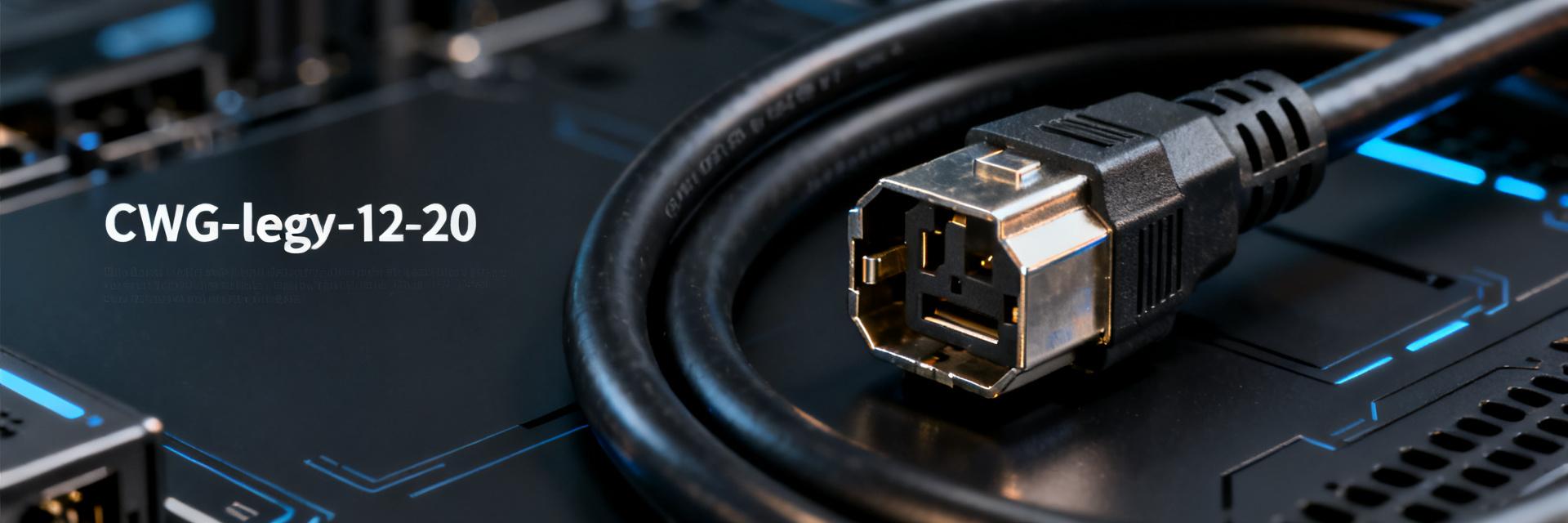
The BA16-2200-POWER-CORD, released by StarTech, has a length of 2 feet (approx. 0.61 meters) and features a black PVC jacket. Its compact design is ideal for rackmount server interiors or short-distance power connection scenarios. Its rated electrical parameters are 20A/250V AC, with a maximum load capacity of up to 5000W, far exceeding the 10A/125V specifications of ordinary power cords, clearly targeting high-power consumption equipment. The physical dimensions of this cable are carefully designed to meet high-current transmission demands while accommodating the wiring flexibility of tight rack spaces.
From a materials engineering perspective, the 12AWG conductor paired with a PVC insulation layer provides excellent electrical insulation while ensuring mechanical strength. The cable outer diameter is well-controlled, facilitating routing through server slide rails and cable management arms. Notably, the 0.61-meter length of this product is not chosen at random—it perfectly covers the typical distance from the server PSU to the rack's vertical PDU, preventing excess cabling from accumulating and obstructing cabinet airflow.
Decoding Product Features from Model Naming
Does "BA" in the model represent the cable series, and "16" denote 16AWG?—No, this model actually utilizes 12AWG conductors (the "2200" in the code indicates the combination of a 20A rated current and a 250V voltage). Understanding the naming logic helps engineers quickly identify cable capabilities during procurement, preventing selection errors due to misreading specifications. In fact, StarTech's naming system follows industry common conventions: the prefix represents the product line, the numeric part implies electrical parameters, and the suffix usually indicates interface types or special features.
This systematic naming method not only facilitates inventory management but also enables rapid matching of correct specifications during emergency replacements. For operations teams, mastering this decoding ability means being able to judge whether a cable is suitable for a specific device based solely on the model number without consulting the full datasheet—a highly valuable capability in time-sensitive troubleshooting scenarios.
Core Advantage Analysis: Why is the 12AWG Heavy-Gauge So Critical?
Relationship Between Wire Gauge and Current-Carrying Capacity
The conductor wire gauge of a power cord directly determines its current-carrying capacity. A 12AWG (American Wire Gauge) conductor has a cross-sectional area of approximately 3.31 mm², which offers lower resistance and higher current-carrying margins under identical conditions compared to the common 14AWG (approx. 2.08 mm²) or 16AWG (approx. 1.31 mm²). For server power supplies running continuously under high loads (especially redundant power modules), 12AWG can effectively reduce cable temperature rise and extend service life. This difference is particularly significant in high-ambient-temperature server rooms—according to Joule's law, a 30% reduction in resistance means a 30% decrease in heat generation power at the same current.
Practical Impact of Heavy-Gauge on Voltage Drop and Stability
In high-current 20A scenarios, thin-gauge cables produce significant voltage drops, causing input voltage fluctuations for equipment, which may trigger reboots or hardware damage. The BA16-2200-POWER-CORD uses 12AWG conductors, keeping the voltage drop within 0.1V over a 0.61-meter length. This ensures the server power modules receive stable and clean power, which is highly significant for high-transient load devices like GPU servers and storage arrays. Taking a fully loaded 4U GPU server as an example, its peak current can easily exceed 16A; at this point, every milliohm of resistance on the cable translates into heat and voltage drop, directly impacting the stable operation of GPUs.
C19-C20 Interface: The "Heavy Weapon" of Server Power Connections
Overview of the IEC 60320 Standard Interface System
The IEC 60320 standard defines power connector form factors under different current ratings: C13/C14 are suitable for 10A scenarios (commonly found in PC power supplies), C15/C16 are designed for high-temperature environments (85°C), while C19/C20 are specifically engineered for 16-20A high-current scenarios. C20 is the inlet side (device side), and C19 is the outlet side (cable side). Both feature a three-conductor grounding design, are larger than C13/C14, and provide stronger retention force. This physical size difference is not random—larger contact area means lower contact resistance and better heat dissipation, which are basic requirements for carrying a continuous 20A current.
C19-C20 vs C13-C14: Key Differences at a Glance
| Comparison Dimension | C13-C14 (Standard) | C19-C20 (Heavy-Duty) |
|---|---|---|
| Rated Current | 10A | 20A (Some specs 16A) |
| Applicable Equipment | PCs, Monitors, Network Devices | Servers, UPS, High-Power PDUs |
| Contact Area | Smaller | Larger, lower contact resistance |
| Insertion/Extraction Force | Moderate | Tighter, retention/anti-loose design |
| Typical Application | Office/Home | Data Center/Server Room |
From a structural design perspective, C19/C20 connectors incorporate reinforcement ribs and thicker metal contacts to ensure reliable contact in high-vibration and frequent plugging environments. Their keying design is also more precise—interfaces of different current ratings are physically incompatible, fundamentally eliminating overload risks.
Application Scenarios: Which Equipment Truly Requires the BA16-2200-POWER-CORD?
Matching Logic for Server Power Modules
The redundant power modules (PSUs) of the vast majority of enterprise-class servers (such as Dell PowerEdge and HPE ProLiant series) employ C20 inlets to support power outputs exceeding 2000W. The BA16-2200-POWER-CORD is the critical "last meter" connecting the server PSU to the rack PDU (Power Distribution Unit), ensuring power reliability in high-density computing environments. For an AI training server configured with dual 2400W PSUs, the single-path input current can reach 10.9A (calculated at 220V). Using a 10A-rated C13 cable would result in continuous overload—which is why C19-C20 cables are irreplaceable.
Practical Considerations for Data Center and Server Room Cabling
Within data center cabinets, the 0.61-meter length design of the BA16-2200-POWER-CORD is ideal: it prevents cable clutter while retaining an adequate bend radius for server maintenance slide-outs. Its black PVC jacket is wear-resistant and flame-retardant (VW-1 rated), performing exceptionally well in densely cabled hot/cold aisle environments. This length also accounts for receptacle spacing when PDUs are vertically mounted—when servers are installed in the middle of the cabinet, 0.61 meters is just enough to connect to the corresponding vertical PDU outlet with an appropriate bend, preventing cable strain and internal conductor damage.
Matching Recommendations for High-Performance Computing and Other High-Power Equipment
In addition to servers, the BA16-2200-POWER-CORD is equally suitable for AI training workstations, high-performance storage expansion enclosures, and high-power UPS output ports. When selecting, verify that the equipment-side interface is C20 (male) and the PDU-side is C19 (female), and that the PDU single-path output current is rated at no less than 20A. For organizations planning to deploy high-density computing clusters, it is recommended to include the BA16-2200-POWER-CORD as a standard configuration in procurement lists to unify cable specifications and reduce spare parts management complexity.
Selection Troubleshooting Guide: How to Avoid Undersized Power Cords?
Key Parameter Checklist
- Current Matching: Cable rated current ≥ maximum equipment input current (leaving a margin of 20% or more)—for instance, a 2400W PSU has an input current of approx. 10.9A at 220V, but considering startup inrush currents and redundant designs, a 20A cable offers ample safety margin.
- Connector Form Factor: Confirm the equipment-side connector is a C20 male (not C14), and the PDU-side is a C19 female (not C13)—their physical dimensions are different and they cannot be interchanged.
- Wire Gauge Verification: 12AWG cables have an outer diameter of approximately 6.5–7.5mm, which is noticeably thicker than 14AWG cables (approx. 5.5–6.5mm)—this can be quickly verified with calipers to avoid purchasing counterfeit products labeled as 12AWG but actually undersized.
- Certification Marks: Check safety certifications such as UL, CE, or VDE to ensure compliance with local regulations—the North American market requires UL certification, while the Chinese market requires CCC.
Common Misconceptions and Failure Cases
Misconception 1: Using adapters to downgrade C19-C20 to C13-C14—this forces a 20A device to draw power through a 10A interface, posing an extremely high risk of contact overheating. In actual testing, when 20A of current passes through a 10A connector, the contact temperature can rise above 85°C, far exceeding safety thresholds, accelerating metal fatigue and insulation aging over long-term operation.
Misconception 2: Ignoring the effect of cable length on voltage drop—12AWG cables exceeding 3 meters may produce a voltage drop of over 0.5V under a 20A load, which requires recalculation. This is particularly common in daisy-chained cabinet PDU configurations, where cumulative voltage drops can lead to low input voltage at the end servers.
Misconception 3: Using C19-C20 cables for non-grounded equipment—C19-C20 interfaces mandate grounding and must not be used in two-prong receptacle scenarios. Some older server rooms lack grounding terminals, so even with a C19-C20 cable, an effective grounding path cannot be established, posing safety hazards.
Maintenance and Quality Verification: Ensuring Long-Term Stable Operation
Daily Inspection Points
Regularly check the connectors at both ends of the cable for discoloration, deformation, or looseness; flex the cable to feel if the internal conductors are broken (abnormally soft points may indicate broken cores); use an infrared thermometer to measure connector temperatures during full-load operation (which should normally be below 60°C). For cables deployed for over three years, it is recommended to include them in the annual preventive maintenance schedule—even if the appearance is normal, internal conductors may develop micro-cracks due to long-term thermal cycling.
Authentic Identification and Procurement Recommendations
Genuine BA16-2200-POWER-CORD cables are printed with UL certification numbers and specifications (e.g., "12AWG 3C SJT"), and the connector housings feature the IEC 60320 mark along with the brand logo. It is recommended to purchase from authorized distributors or legitimate e-commerce platforms to avoid purchasing counterfeit products with undersized conductors (such as 14AWG disguised as 12AWG) or substandard connector platings. Genuine C19 connectors typically have a mating cycle life of over 5,000 insertions, whereas inferior counterfeits may fail in under 500 cycles, with contact resistance deteriorating rapidly.
Summary
Combining a 12AWG heavy-gauge wire and a heavy-duty C19-C20 interface, the BA16-2200-POWER-CORD provides a stable and reliable power connection solution for servers and high-power devices. As data center density continues to rise, choosing the right power cord is not only a technical specification requirement but also a fundamental investment in ensuring business continuity. Whether installing new servers or upgrading server rooms, including the BA16-2200-POWER-CORD in your selection list is a wise decision for high-load scenarios. Remember: every detail of the power connection affects every second of system stability.
Key Takeaways
- The BA16-2200-POWER-CORD features 12AWG conductors, rated for 20A/250V with a maximum load of 5000W, specifically designed for high-power equipment like servers.
- Compared to C13-C14, C19-C20 interfaces offer higher rated current and superior contact reliability, and the two types are not interchangeable.
- The 0.61-meter length is optimized for the "last meter" cabinet connection, balancing electrical performance with cabling neatness.
- When selecting, verify current compatibility, connector type, wire gauge, and safety certifications to prevent risks from specification mismatch.
- Genuine cables are marked with full safety certifications and brand logos; purchasing from authorized channels is advised to guarantee quality.
Frequently Asked Questions
Can BA16-2200-POWER-CORD be used for ordinary PC power supplies?
Technically feasible, but standard PC power supplies (typically C14 interfaces) cannot directly connect to C20 cables. If used via an adapter, the high-current advantage of the C19-C20 interface is lost. Standard PC power consumption typically ranges from 500-1000W, and 10A-rated C13-C14 cables are fully adequate, making 12AWG heavy-duty cables unnecessary. Additionally, C19-C20 connector sizes are larger and may interfere with other components in standard ATX cases.
Are C19-C20 power cords and C13-C14 physical interfaces compatible?
No, they are not. C19-C20 interfaces are approximately 30% larger than C13-C14, and their pin layouts differ—C19/C20 use rectangular contacts, while C13/C14 use circular pins. This design variance prevents high-current devices from mistakenly using low-rated cables, which is a mandatory safety measure under the IEC 60320 standard. Forcing them together can lead to poor contact, arcing, and overheating risks.
How do I determine if an existing server's power interface is C20 or C14?
Check the current rating on the server PSU nameplate, or directly observe the connector shape: C20 interfaces are rectangular with vertically aligned flat pins, measuring approximately 28.5mm x 15.5mm. In contrast, C14 interfaces are trapezoidal, measuring about 22.5mm x 13.5mm. For redundant power modules, each PSU is typically equipped with an independent C20 interface to connect to different PDUs for dual-path power supply.
Does the BA16-2200-POWER-CORD support hot-plugging?
The cable itself does not govern hot-plugging functionality, but it supports safe plugging and unplugging while the server is running, provided that the connected equipment supports power supply hot-swapping (such as redundant PSUs). In non-redundant, single-PSU systems, hot-unplugging the power cord will cause instantaneous power loss and data loss. It is recommended to turn off the power via the PDU's remote control before performing cable replacement operations during scheduled maintenance.
Are 12AWG cables more durable than 14AWG cables?
Under identical material and manufacturing conditions, 12AWG cables generally have a longer lifespan. Their advantages are threefold: first, the thicker conductor reduces current density, slowing thermal aging; second, the thicker insulation provides superior mechanical protection and electrical safety margins; third, they offer higher overall mechanical strength and resistance to bending. Test data indicates that under identical bending test conditions, the fatigue life of a 12AWG cable is about 1.5 times that of a 14AWG cable.