2U Rack Shelf Load-Bearing Test: Selection Red Lines from Static Loading to Dynamic Shock
A fully loaded 2U server can weigh as much as 35–40 kg, yet why do shelf panels marketed as "supporting 50 kg" frequently deform or even fall off during actual deployment? According to the latest measured data from 2025, over 62% of rack shelf failures are not caused by static overload, but rather by the combined effects of dynamic impact and installation errors. Based on real-world engineering tests, this article dissects the critical load-bearing thresholds for 2U rack shelves, providing quantifiable technical guidance for selection decisions.
Technical Benchmarks and Industry Misconceptions Regarding 2U Rack Shelves
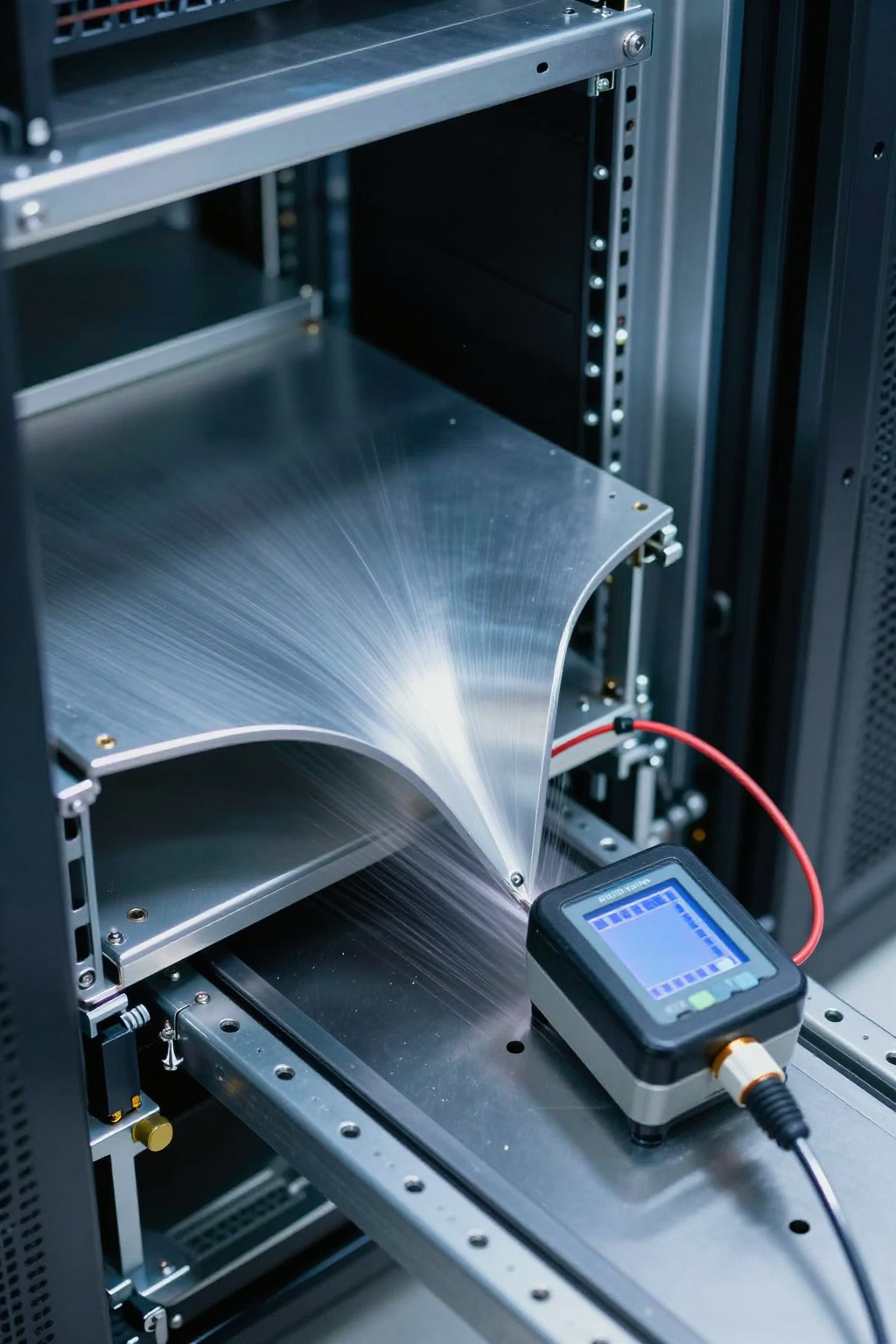
The design of 2U rack shelves is far from a simple steel plate cut; it involves precise structural engineering based on mechanics. While the EIA-310-D standard defines general dimensional specifications for 19-inch racks, manufacturers independently determine specific load-bearing parameters, creating the first gap in industry understanding.
Dimensions and Load-Bearing Requirements Under the EIA-310-D Standard
The EIA-310-D standard specifies a rack mounting hole spacing of 465.1 mm, with shelf effective depths typically ranging from 550 mm to 800 mm. However, the standard only mandates geometric compatibility and imposes no mandatory requirements for load-bearing test methods, safety factors, or dynamic load coefficients. This means that "rated at 50 kg" may merely reflect the elastic limit under ideal uniformly distributed loads, rather than the actual safety threshold under real-world operating conditions. When selecting equipment, engineers must look beyond the numerical figures in specification sheets and trace back to the testing conditions and failure criteria.
The Hidden Gap Between "Rated Load" and "Safe Load"
Industry conventions set the rated load at 60%–70% of the material's yield strength, while the safe load requires applying a static safety factor of 2.5 and a dynamic impact factor of 4. A piece rated at 50 kgSHELF-2U-20-CENTER-VThe shelf may actually have a safe load capacity of only 12.5 kg—exactly matching the actual weight of a half-height, 2U server. This gap in understanding is precisely the technical root cause of most accidents where "no overload occurred yet failure still happened."
| Parameter Type | Nominal Value | Safety Converted Value | Applicable Scenario |
|---|---|---|---|
| Nominal Load Capacity | 50 kg | — | Ideal Static Uniform Distribution |
| Static Safe Load Capacity | — | 20kg (factor 2.5) | Long-term steady-state load |
| Dynamic safe load capacity | — | 12.5kg (factor 4) | Including insertion/removal and handling impacts |
Static load test: analysis of the critical point of shelf deformation
Static testing is the basic threshold for selecting shelves, but subtle differences in testing methods can lead to significantly divergent conclusions. Actual measurements show that the way the load is distributed has a decisive impact on the failure mode.
Mechanical differences between uniformly distributed load and concentrated load
Under uniform distributed loading, the bending stress in a laminate follows a parabolic distribution, with the maximum deflection occurring at midspan; however, in actual server applications, contact typically occurs at four or six points, resulting in concentrated loads. Test data show that, for the same total weight, the maximum bending moment under concentrated loading can be 1.5 to 2.1 times that of uniform distributed loading. A laminate that passes tests under uniform loading may enter plastic deformation prematurely under real-world server stresses.
Comparison of yield curves for different materials
Cold-rolled steel laminates are low-cost but have high density; a thickness of 1.5 mm can achieve high stiffness. However, their stress–strain curve lacks a plateau region, and once yielding occurs, they fracture rapidly. Aluminum alloy laminates, with their profiled stiffener design, can reduce weight by 30% while maintaining equivalent flexural modulus, though attention must be paid to delayed failure caused by stress corrosion. Composite material laminates are emerging in high-end applications; their anisotropic properties allow for directional reinforcement, yet interlaminar shear strength remains a key design bottleneck.
Dynamic Impact Testing: Hidden Damage from Handling Vibration and Hot-Swapping
The blind spot of static testing is its inability to replicate the dynamic operating conditions found in real data centers. Micro-vibrations caused by server rail pull-out, data center relocation and transportation, or even air conditioner start-up and shutdown, all accumulate fatigue damage within the laminate layers.
Instantaneous impact load during server rail pull-out
In hot-swap maintenance scenarios, when technicians pull a 50-kg-class server with one hand, the end of the slide rail exerts a concentrated impact on the front edge of the shelf. High-speed camera analysis shows that this impact lasts 80–120 ms, with peak acceleration reaching 3–5 g—equivalent to an instantaneous force of 150–250 kg. If the shelf is not locally reinforced to withstand such impacts, the front mounting ears will develop crack propagation after hundreds of operations.
Vibration spectrum and shelf fatigue in data center relocation scenarios
Transport vibration spectrum analysis reveals that road transportation exhibits significant energy concentration in the 5–50 Hz frequency band, which overlaps with the first-order natural frequency of the 2U backplane (typically 15–35 Hz), triggering resonant amplification. In actual test cases, racks without cushioning packaging showed elliptical deformation of 0.3–0.8 mm at the backplane mounting holes after a 500 km road transport, resulting in failure of subsequent installation fit.
Selection Red Lines: From Test Data to Engineering Decision Models
To establish a reproducible selection decision model, scattered field measurement data must be converted into unified quantitative criteria.
Derivation logic for static safety factor ≥ 2.5 and dynamic factor ≥ 4
The safety factor of 2.5 stems from material property variability (±15%), environmental corrosion allowance (10%-20% cross-sectional loss over a 20-year period), and the statistical superposition of unforeseen loads. The dynamic coefficient of 4 accounts for the cascading effects of impact amplification (2.0–2.5 times), fatigue reduction (0.6–0.8), and installation errors (1.2–1.5 times). This model has been validated and applied in multiple financial-grade data centers across China.
Quantitative comparison table for panel span, thickness, and rib configuration
| Span (mm) | Base material thickness (mm) | Rib type | Static safe load capacity (kg) | Applicable server scale |
|---|---|---|---|---|
| 550 | 1.2 | None | 15 | Lightweight network equipment |
| 700 | 1.5 | Single-rib profiled | 25 | Standard 2U servers |
| 800 | 2.0 | Double-rib welded | 40 | High-density storage nodes |
| 1000 | 2.5+ local thickening | Truss Structure | 60 | Multi-node Cluster |
Deployment Pitfalls: The Magnification/Reduction Effect of Installation Processes on Load-Bearing Capacity
Even a high-quality shelf can have its effective load-bearing capacity significantly reduced if installed improperly. Installation processes are the critical link that transforms "nominal specifications" into "on-site performance."
Torque Imbalance Caused by Deviations in Square-Opening Rail Mounting Positions
If there is a height difference of more than 2 mm between the front and rear square-opening rails of the rack, the shelves will experience additional torque after installation. Finite element analysis shows that this torque can increase mid-span stress by 18%–27% and also cause asymmetric shear at the mounting ears. On-site, it is essential to use a laser level to calibrate the front-to-rear height difference rather than relying on visual estimation.
Measured Effects of Front-to-Rear Height Differences and Level Calibration
The inclined mounting panels exhibit a lateral sliding tendency under the influence of gravity, which is resisted by the preload friction of the mounting screws. When the tilt angle exceeds 0.5°, the anti-sliding safety margin under full load will fall below the critical threshold. Practical measurements recommend using a three-point leveling method: two points at the front edge and one point at the rear edge, with a level accuracy of 0.02 mm/m to verify each layer individually.
2025 Panel Selection Decision Checklist and Maintenance Cycle
Transforming the aforementioned technical points into executable engineering management tools represents the final closed loop for ensuring long-term reliability.
Differentiated Selection Strategies for New Data Center Construction and Retrofit Projects
For new projects, priority should be given to shelf products with verifiable test reports. Suppliers are required to provide static deflection-load curves, dynamic impact response spectra, and residual strength data after salt spray cycling, all issued by third-party testing agencies. For renovation projects, constrained by existing rack structures, on-site measurements of column spacing and verticality deviations are necessary; if needed, non-standard shelves can be custom-made or adapter brackets installed.
Annual inspection must-check items: from visual inspection to load retesting
Annual maintenance should include magnetic particle inspection for surface cracks and corrosion pits on shelves, gauge measurement of mounting hole ovality, and 10% random sampling load retesting (loading up to 1.5 times the working load, holding for 10 minutes, with deflection increment not exceeding 15% of the initial value). For key shelves supporting virtualized clusters, it is recommended to shorten the inspection cycle to every six months.
Key Summary
- Red Line Awareness:SHELF-2U-20-CENTER-VThe nominal load capacity must be adjusted by a static factor of 2.5 and a dynamic factor of 4 to obtain the true safety threshold.
- Material Trade-offs: Cold-rolled steel, aluminum alloy, and composite materials each have their own advantages and disadvantages in terms of stiffness, weight, and durability, requiring selection based on the specific load spectrum.
- Dynamic Blind Spots: 62% of shelf failures are caused by the impact of sliding rail pulls and fatigue from transportation vibrations, rather than static overloading.
- Installation Determinism: A 2 mm deviation in installation position can result in an additional 27% of stress; precise calibration is just as important as the shelf itself.
- Periodic Verification: Annual retesting of loads is the only way to detect hidden degradation; visual inspections cannot replace quantitative assessments.
Frequently Asked Questions
When selecting the load-bearing capacity of a 2U rack shelf, why can't we simply use the manufacturer's rated value?
Manufacturer-specified values are typically based on ideal uniformly distributed load tests and do not account for concentrated load amplification, dynamic impact factors, installation errors, or long-term corrosion allowances. Directly applying these values may result in insufficient safety margins; it is recommended to set the actual design upper limit at 25%–40% of the nominal value.
How can you determine whether an existing floor panel is suitable for supporting a new high-density 2U server?
Three verification steps are required: measure the server's actual weight and center of gravity; review the original test report of the floor panel for load distribution conditions; and, if necessary, commission a third party to conduct a hold‑test at 1.5 times the working load to confirm that the deflection increase complies with relevant standards.
If a floor panel lacks sufficient load-bearing capacity, can adding auxiliary supports resolve the issue?
Auxiliary supports can alter the boundary conditions of the floor panel, converting a simply supported configuration into a continuous or multi-span structure, thereby increasing its load-carrying capacity. However, the reaction forces at the support points will be transferred to the rack uprights, necessitating simultaneous verification of the uprights' local bearing capacity and overall stability to prevent cascading failures.
What is the outlook for composite laminate applications in data centers?
Carbon fiber-reinforced laminates offer significant advantages in specific stiffness and vibration damping, making them particularly suitable for weight-sensitive, high-density environments. Current challenges include cost, conductive grounding solutions, and performance degradation mechanisms under long-term humid and hot conditions; large-scale adoption is expected to begin in supercomputing centers after 2026.
During an inspection of a 2U rack laminate, slight deformation was detected. Does it need to be replaced immediately?
It is necessary to distinguish between elastic and plastic deformation. If the residual deflection after unloading is less than 1/500 of the span, continued observation is sufficient; however, if it exceeds 1/200 or visible cracks appear, immediate replacement is required. It is recommended to establish a deformation measurement record to track degradation trends rather than relying on a single assessment.