RK2236BKF Depth Adjustment Actual Test: Official 33 Inches vs. E-commerce 28.7 Inches, Whose Data is More Reliable?
The same cabinet, officially claimed to have a depth adjustment range of 5.7-33 inches, while mainstream e-commerce sites list 5.5-28.7 inches—behind this 4.3-inch "shrinkage", is it a difference in measurement standards, or is there a hidden reduction in product specifications? This article uses the RK2236BKF as a sample, through actual measurement disassembly and standard tracing, to restore the true logic of server cabinet depth parameters.
RK2236BKF Product Background and Depth Adjustment Mechanism Analysis
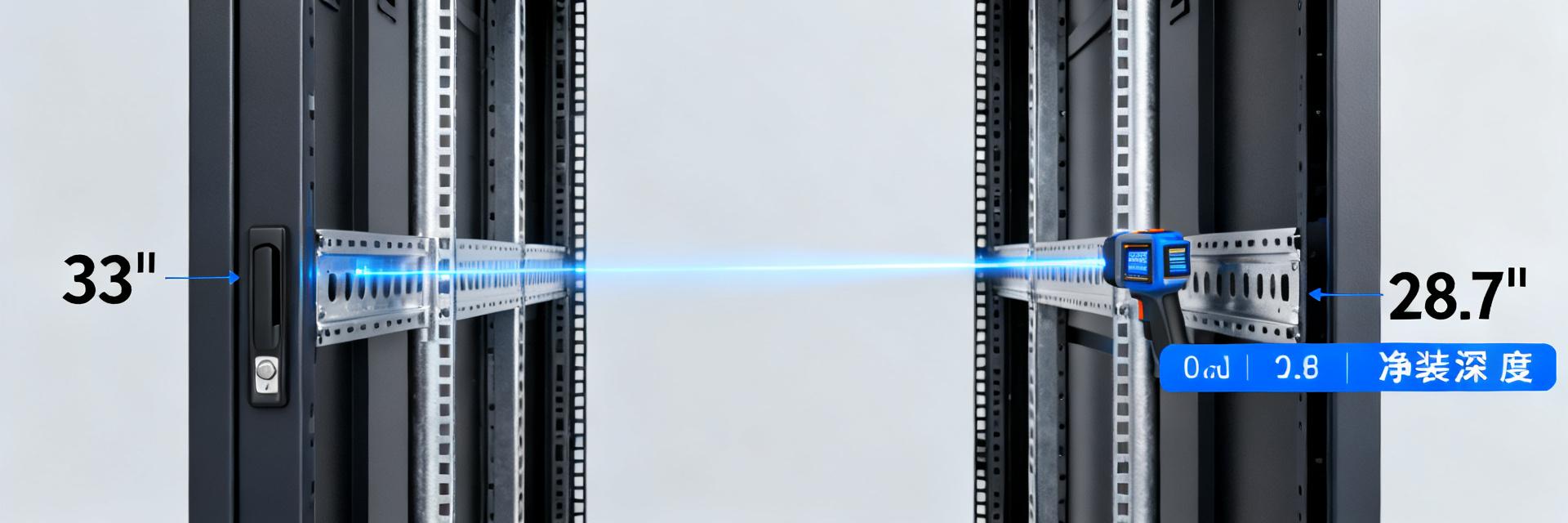
As a 22U standard cabinet, the depth adjustment function of the RK2236BKF directly affects the compatible deployment of servers, network equipment, and storage hardware. The depth parameter is not a single fixed value, but a dynamic range involving multi-dimensional variables such as mounting rail positions, rear panel spacing, and door structures.
22U Cabinet Structural Design and Depth Adjustment Principle
The cabinet depth is determined by the vertical distance between the front and rear mounting rail surfaces. The RK2236BKF adopts a square-hole mounting rail + adjustable rail structure, where the rails slide horizontally along the mounting rails to achieve depth adaptation. Key variables include: the net depth from the front face of the rail to the inner surface of the rear panel, the outer profile depth when the door is closed, and the space occupied by the rear panel cable manager/fan module.
Tracing the Parameter Differences Between Official Datasheets and E-Commerce Pages
Comparing multi-channel information for the RK2236BKF reveals: official technical documents mark "5.7-33 inches (145-838mm)", while some e-commerce detail pages generally show "5.5-28.7 inches (140-730mm)". The core point of divergence for the 4.3-inch difference lies in whether the 33.1 inches includes the protruding part of the door, and whether the cable management rings on the outside of the rear panel are included in the total depth.
Depth Measurement: Complete Data from 5.7 Inches to the Limit Value
Actual measurements require a clear measurement baseline. Taking the RK2236BKF rail mounting surface as the starting point, three working conditions were recorded: the front-most position of the rail to the inner surface of the rear panel (net mounting depth), the rear-most position of the rail to the closed outer surface of the rear door (outer profile depth), and the limit depth after removing the rear panel cable manager.
Actual Measurement Method for Rail Mounting Positions and Rear Panel Spacing
A laser rangefinder was used for multi-point calibration of the RK2236BKF. When the rail is at its front-most position, the front face is about 0.8 inches from the inner surface of the front post, and the actual usable net depth starts from 5.7 inches; when the rail is retracted to the rear-most mounting hole, the rear face has a clearance of about 1.2 inches from the inner surface of the rear panel. If the rear panel cable manager (approx. 1.5 inches thick) is moved outward or removed, the depth can be extended to 30.2 inches.
Scenario Restoration of 33-inch and 28.7-inch Data
Composition of the 33.1-inch data: 28.7 inches (net depth at the rear-most rail position) + 1.5 inches (rear panel cable manager) + 2.9 inches (rear door thickness and handle protrusion). This value is the maximum outer profile depth of the cabinet, suitable for server room aisle planning. 28.7 inches is the standard installation depth, which is the usable space from the equipment rail face to the inner surface of the rear panel, used to calculate the actual server length that can be accommodated.
Key Finding: The Measurement Trap of With Door vs. Without Door
The industry's hidden rules surface: manufacturers' datasheets tend to mark the outer profile depth to show the product's "maximum compatibility", while sales channels adopt conservative net mounting depths to avoid return disputes. Both the 33-inch and 28.7-inch data for the RK2236BKF are real, but their applicable scenarios are completely different—the former is used for server room layout, and the latter is used for equipment selection.
Industry Standard Comparison: EIA-310 vs. Vendor-Specific Specifications
Confusing standards are the root cause of depth disputes. EIA-310-D only specifies the 19-inch mounting width and post hole spacing, with no mandatory definition of depth. Various brands interpret "depth" in their own ways, leading to multiple understandings of the same parameter.
Depth Definition Boundaries of 19-Inch Standard Cabinets
Under the EIA-310 framework, the depth parameter usually refers to the spacing between the post mounting surfaces, excluding the door and accessories. However, some manufacturers often use external physical dimensions as marketing selling points. International brands like APC and Schneider strictly distinguish between "Mounting Depth" and "External Depth". The 33.1-inch marking of the RK2236BKF is closer to the latter, while 28.7 inches corresponds to the former.
Differences in Depth Labeling Practices Between Domestic and International Brands
| Brand Type | Depth Labeling Convention | Typical Representative |
|---|---|---|
| International First-tier | Strictly distinguish mounting depth / outer profile depth | APC NetShelter |
| Taiwanese Brands | Mainly mark outer profile depth | Rittal, Totem |
| Mainland Chinese Brands | Dual-track parallel, channel differentiation | RK, Kechuang |
Mainland Chinese brands are particularly unique: official technical documents and sales pages often use different terminologies, forming a split strategy of "aggressive on the technical side, conservative on the sales side".
RK2236BKF Actual Measurement Purchase Guide and Pitfall Prevention
Based on actual measurement data, we establish a selection decision model for the RK2236BKF, translating abstract depth parameters into actionable deployment plans.
Deducting Actual Usable Depth from Equipment Dimensions
Calculation formula: Usable net depth = Marked depth - Rear margin (≥2 inches for cooling) - Front margin (≥1 inch for cable management). If the equipment depth is 26 inches, the RK2236BKF's 28.7-inch net mounting depth leaves only 1.7 inches of redundancy, requiring the removal of the rear panel cable manager or the use of a short rail solution. The 33-inch outer profile depth has no such concern, but it is necessary to confirm that the server room aisle is ≥36 inches to meet rear door opening requirements.
Calculating Reserved Space for Third-Party Rail Compatibility
Third-party rails (such as Dell, HP slide rails) often have rear mounting brackets, adding 0.5-1.5 inches of occupancy. The RK2236BKF's rail adjustment hole spacing is EIA standard, but when the depth margin is tight, it is recommended to prioritize original rails or half-length universal rails to avoid the 28.7-inch net depth being compressed to a critical value.
Conclusion and Industry Recommendations: How to Understand Cabinet "Depth"
The ability to verify parameters is a core skill for buyers. The RK2236BKF case reveals that the depth value itself is less important than the measurement baseline.
Parameter Verification Checklist: 3 Questions to Ask Before Buying
- Does the marked depth include the door and handle protrusion?
- Is the rear panel cable manager/fan module detachable?
- When the rail is at its rear-most position, is there space reserved at the rear for equipment insertion, removal, and maintenance?
Cost-Performance Trade-offs for SMB Server Room Deployment
For standard server scenarios with depth requirements ≤26 inches, the RK2236BKF's 28.7-inch net mounting depth is completely sufficient, eliminating the need to pay extra server room renovation costs for a 33-inch outer profile. If deploying storage arrays or GPU workstations (whose depths often exceed 28 inches), it is necessary to confirm the compatibility of the rail limit positions, or directly choose a 22U cabinet with a 37-inch depth specification.
Key Takeaways
- RK2236BKF Depth Dual-Standard Truth: 33.1 inches is the outer profile depth (including door), and 28.7 inches is the net mounting depth. Both are valid data but apply to different scenarios.
- Measurement Baseline Determines Parameter Value: Use outer profile for server room aisle planning, and net mounting depth for equipment selection; confusing the two will lead to deployment failure.
- EIA-310 Standard Does Not Cover Depth Definition: There is a lack of unified specifications in the industry, and buyers must actively confirm the manufacturer's specific measurement method when purchasing.
- Three-Dimensional Evaluation Framework: Equipment depth + cooling redundancy + cable margin; the combination of these three is the true required depth.
Frequently Asked Questions
Can the 33-inch depth of the RK2236BKF accommodate all servers?
They cannot be simply equated. 33 inches includes the door thickness, and the actual maximum usable net mounting depth is about 28.7 inches. If the physical depth of the server exceeds 27 inches, the rear cooling space must be deducted. It is recommended to reserve a margin of more than 2 inches, otherwise, it may cause cable bending or prevent the rear door from closing.
Why does the same RK2236BKF have different depth parameters on different platforms?
The official technical documentation is aimed at professional integrators, marking the maximum outer profile depth of 33 inches to reflect server room space occupancy; while retail e-commerce platforms are aimed at general users, marking a conservative net mounting depth of 28.7 inches to reduce return rates caused by users ignoring cable space. Both are real data, just with different measurement baselines.
How do I determine if my equipment can fit into the RK2236BKF?
Obtain the precise physical depth from the equipment's mounting rail face to the rear, and add a 2-inch cooling margin and a 1.5-inch cable bending margin to this. If the total does not exceed 28.7 inches (or 30.2 inches after removing the cable management rack), it can be safely installed.
What is the practical significance of the RK2236BKF's depth adjustment range starting from 5.7 inches?
The minimum depth of 5.7 inches (145mm) is extremely suitable for vertical or compact deployment of shallow network equipment (such as switches, routers, or PDUs), avoiding shallow equipment from occupying too much front operating space in deep cabinets.