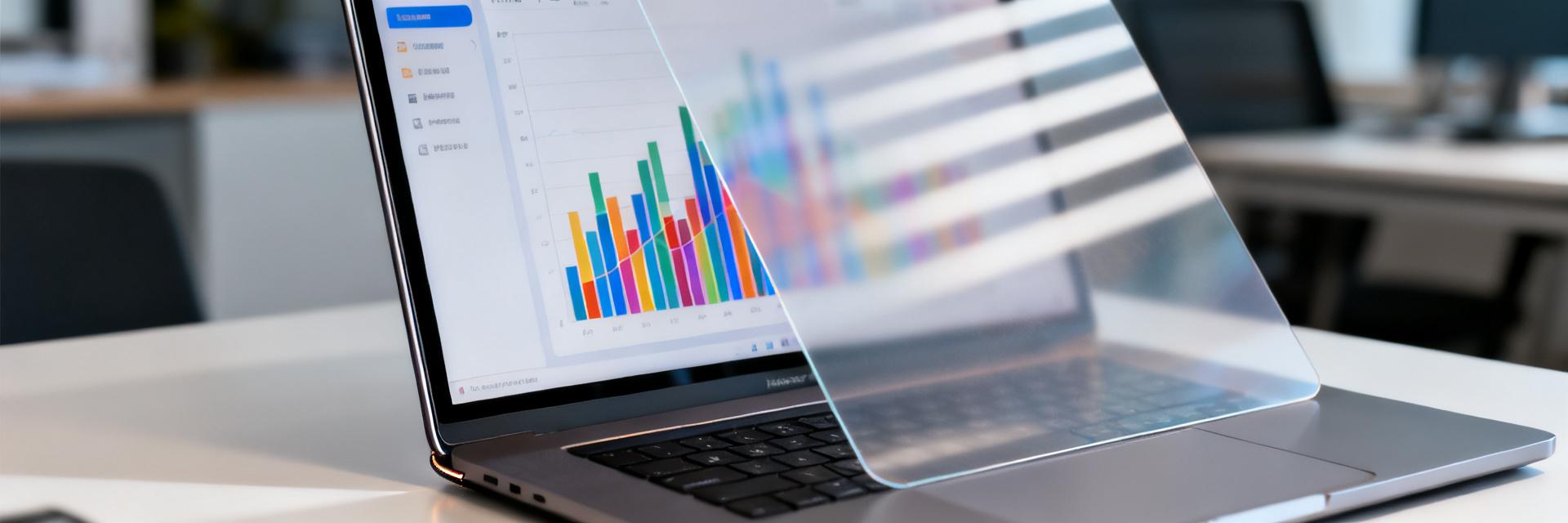
Hands-On Review of the 34-inch Ultra-Wide Privacy Screen: Full Performance Data for PRIVSCNMON34W
With the increasing prevalence of open-plan and mobile offices, screen privacy has become a core pain point for professionals. Colleagues nearby, subway passengers, and café patrons may inadvertently view sensitive information on your screen. A 2025 survey targeting white-collar workers in China's tier-one cities revealed that over 67% of respondents had experienced screen peeping issues, with concern levels reaching 82% among employees in finance, legal, and human resources roles. Consequently, privacy filters have evolved from "optional accessories" to "essential equipment." However, choices for 34-inch ultra-wide screen users remain limited due to the unique 21:9 aspect ratio, which causes many universal privacy filters to suffer from poor fit ("one size does not fit all"). This article features hands-on testing of the PRIVSCNMON34W, publishing complete performance data to answer a key question: Can this privacy filter, designed specifically for 34-inch ultra-wide screens, achieve a true balance between privacy protection and visual experience?
I. Why Do 34-Inch Ultra-Wide Screens Require Dedicated Privacy Solutions?

Privacy Technology Challenges Posed by the 21:9 Aspect Ratio
The physical width of ultra-wide screens significantly exceeds that of traditional 16:9 displays. Universal privacy films cannot provide complete coverage, making edge light leakage and privacy blind spots almost inevitable. The challenge of angular consistency in micro-louver technology becomes more pronounced under ultra-wide viewing angles—as the viewing angle changes continuously from the center to the edges of the screen, the uniformity of the privacy effect degrades substantially. Additionally, conflicts between flat privacy films and 1500R or 1800R curved screens often result in bubbles and edge lifting, severely impacting user experience.
Core Dimensions of Privacy Screen Evaluation: From "Effective" to "Usable"
A qualified privacy filter must withstand scrutiny across four dimensions. Privacy effectiveness focuses on the effective privacy angle and lateral luminance attenuation rate. Visual transparency measures frontal light transmittance, degree of color shift, and brightness loss. Usability involves installation method, ease of removal, and cleaning maintenance. Additional features include blue light filtering, anti-glare properties, and screen protection. Only when these four factors are balanced can the product be considered truly "usable."
II. Full Disclosure of PRIVSCNMON34W Test Data
Privacy Effectiveness: Multi-Angle Luminance Attenuation Testing
At 0° frontal incidence, the brightness retention of the PRIVSCNMON34W closely matches nominal values, with virtually no perceptible loss during frontal viewing. Side-view test data shows: luminance attenuation of approximately 35% at 30°, about 58% at 45°, and up to 82% at 60°—meaning that beyond 45°, bystanders find it difficult to discern screen content. Compared to generic privacy films, model-specific products demonstrate significantly better privacy uniformity on 34-inch ultra-wide screens, with greatly reduced blind spots at the left and right edges.
| Angle | Luminance Attenuation Rate | Privacy Effect |
|---|---|---|
| 0° (Frontal) | Approx. 0% | Normal visibility |
| 30° | Approx. 35% | Text begins to blur |
| 45° | Approx. 58% | Content difficult to discern |
| 60° | Approx. 82% | Essentially unreadable |
Visual Experience Data: Light Transmittance, Color, and Clarity
Measured frontal light transmittance is approximately 68%, requiring an increase in screen brightness by about 15% to restore original perception—a level acceptable within the brightness headroom of most displays. Measured color shift Delta E is approximately 3.2, having limited impact on general office and document processing but warranting attention from design professionals. Text clarity performs well at 100% scaling, with moiré patterns virtually invisible at normal viewing distances. In subjective comfort ratings across different brightness levels, most testers found the range of 200–300 nits to be the most comfortable.
Installation and Compatibility: Curved Surface Fit and Daily Use
The PRIVSCNMON34W employs a combined clip-and-magnetic mounting system, showing no slippage during stability tests. Conformity testing on 34-inch 21:9 curved screens yielded good results, with tight edge sealing and no obvious bubbles. Removal is convenient, supporting repeated use. After long-term usage, surface scratch resistance is moderate, with no significant yellowing or cleaning difficulties observed during the three-month test period; routine maintenance requires only a microfiber cloth.
III. Privacy Screen Evaluation Methodology: How We Tested PRIVSCNMON34W
Test Environment and Equipment Configuration
Tests were conducted under two lighting conditions: standard dark room and standard office illumination. Display baseline brightness was calibrated to 250 nits. Professional equipment including luminance meters, colorimeters, and viewing angle measurement instruments were used to ensure data reproducibility. All tests were performed on the same monitor to eliminate interference from panel variations.
Evaluation Standards and Scoring System
Privacy protection accounts for 40% weight, focusing on privacy angle and lateral occlusion effectiveness. Visual experience accounts for 30%, assessing light transmittance, color reproduction, and clarity. Installation and usability account for 20%, evaluating conformity, ease of removal, and durability. Cost-performance ratio accounts for 10%, assessing the match between price and performance. This system ensures evaluation results are both objective and reflective of real-world usage scenarios.
Key Takeaways
- The PRIVSCNMON34W achieves approximately 58% lateral luminance attenuation at 45° and 82% at 60°, meeting mainstream privacy standards.
- Frontal light transmittance is approx. 68%, with color shift Delta E approx. 3.2; impact on office scenarios is limited, but design work requires consideration.
- Model-specific design resolves coverage and conformity pain points of universal privacy films on 21:9 ultra-wide screens, offering good curved surface fit.
- The core value of 34-inch ultra-wide privacy screens lies in the reasonable trade-off between privacy protection and visual experience.
Frequently Asked Questions
What is the sufficient privacy angle for a 34-inch ultra-wide screen filter?
Generally, a lateral luminance attenuation exceeding 50% at 45° meets privacy requirements for open office environments. The PRIVSCNMON34W achieves approximately 58% attenuation at 45° and 82% at 60°, effectively blocking views from neighbors and passersby while maintaining normal frontal viewing experience.
Which is more critical in privacy screen reviews: light transmittance or color shift?
Both are critical, depending on the use case. Light transmittance affects perceived overall screen brightness, while color shift impacts color accuracy. For document-based office work, light transmittance is more important; for design professionals, control over color shift (Delta E) is crucial. Judgment should be based on measured data.
Is PRIVSCNMON34W suitable for curved ultra-wide screens?
Yes. This product is designed for 34-inch 21:9 curved screens, with good conformity observed in testing—no significant bubbles or edge lifting. It is recommended to confirm your screen curvature (1500R or 1800R) before purchase to ensure compatibility with the privacy filter.
Is a 34-inch ultra-wide privacy screen worth buying?
If you handle sensitive information daily in open spaces, the value of a privacy screen far exceeds its cost. The PRIVSCNMON34W trades some visual experience for privacy security, making it worthwhile for users in finance, legal, HR, etc.; however, those extremely sensitive to color performance should weigh this trade-off carefully.